Passport Photo Expression Guide
Master the perfect neutral expression for your passport photo. Learn what's allowed, why it matters, and techniques to look natural while meeting official requirements.
Understanding Expression Rules in Passport Photos
If you have ever wondered why passport photos always look so serious, the answer lies in biometric technology. Modern passports use facial recognition systems that work best when your face is in a neutral, natural state. This guide will help you understand exactly what expression is required and how to achieve it without looking awkward or angry.
The challenge most people face is not knowing how to look neutral without appearing forced. Many end up looking tense, angry, or uncomfortable. By understanding the science behind these requirements and practicing a few simple techniques, you can take a passport photo that looks both professional and naturally you.
A good passport photo expression should not look like a pose. It should look like a relaxed moment captured cleanly and clearly. That is why the best results usually come from a calm face, steady eyes, and a mouth that is naturally closed rather than tightly held in place.
Official Expression Requirements
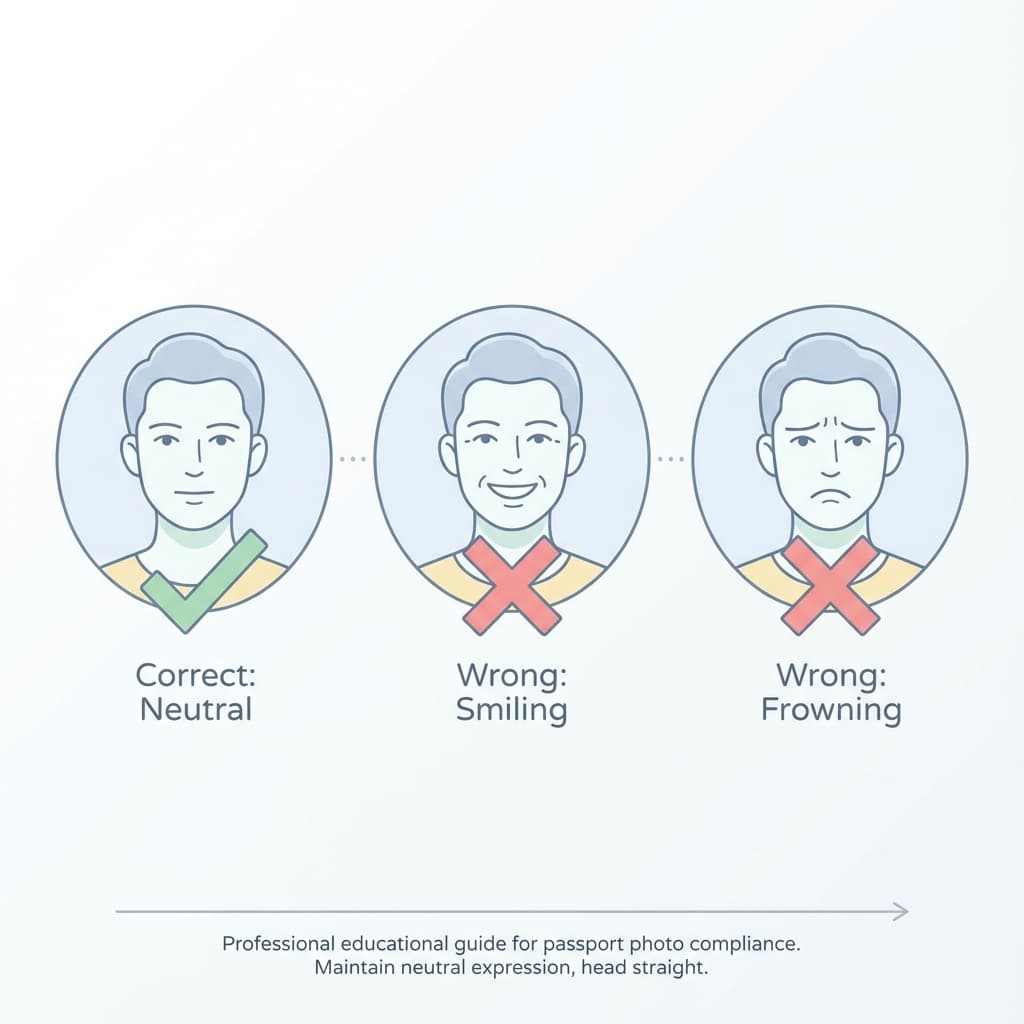
According to Indian passport guidelines and ICAO (International Civil Aviation Organization) standards, your passport photo must show a neutral expression. Here is exactly what that means:
Neutral does not mean expressionless in a robotic sense. It means your features should stay relaxed and consistent so the photo reflects your everyday face. Small variations happen naturally, but the overall look should be calm, direct, and easy to verify.
| Feature | Requirement |
|---|---|
| Mouth | Closed, lips together naturally |
| Smile | Not allowed, no visible smile |
| Eyes | Open naturally, looking at camera |
| Eyebrows | Natural position, not raised |
| Forehead | Relaxed, no frown lines |
| Overall | Relaxed, natural resting face |
Why Do Passports Require Neutral Expression?
The neutral expression requirement exists for several important reasons related to security and identification technology:
Even small facial changes can affect how software reads your face. A smile may lift the cheeks, narrow the eyes, and change the mouth shape enough to make a passport photo less reliable. A neutral face keeps the photo closer to your true baseline appearance.
Biometric Matching
Facial recognition algorithms measure distances between key facial points. Smiling changes these measurements significantly, reducing matching accuracy by up to 20 percent.
Human Verification
Immigration officers need to match your face to your photo quickly. A neutral expression is easier to compare because it shows your default facial structure.
Consistency Across Time
Passports are valid for 10 years. Your neutral face changes less over time compared to your smile, making long-term identification more reliable.
Global Standards
ICAO standards ensure all countries use the same photo requirements, making international travel verification seamless across different immigration systems.
The Psychology Behind Looking Natural
Here is the interesting part: when you try to make a neutral expression, you often end up looking tense or uncomfortable. This happens because:
- Self-consciousness: Knowing you are being photographed triggers self-awareness
- Muscle tension: Trying to hold a specific look creates facial tension
- Overthinking: Actively thinking about your expression makes it feel forced
- Camera anxiety: Some people naturally tense up in front of cameras
The solution is counterintuitive: stop trying to look neutral. Instead, focus on relaxation. Your natural resting face is already neutral. The goal is to capture that relaxed state rather than create an artificial pose.
It also helps to think in terms of stillness rather than stiffness. Stillness keeps your expression calm. Stiffness shows up as a tight mouth, raised brows, or a jaw that looks clenched. A short breathing routine before the photo usually solves more problems than trying to force a look in the mirror.
Tips for Achieving a Natural Neutral Look
The best passport photos often come from people who take a moment to settle in before the camera starts. If you rush, the face tightens. If you pause, breathe, and let the body relax, the expression usually improves on its own.
Before the Photo
- ✅ Relax your jaw: Let your jaw drop slightly, then bring it back. This releases tension.
- ✅ Take deep breaths: Three slow, deep breaths calm your nervous system.
- ✅ Shake it out: Gently shake your head and shoulders to release muscle tightness.
- ✅ Moisten your lips: Dry lips can make you look tense. A quick lick helps them sit naturally.
- ✅ Think pleasant thoughts: Recall a calm, happy memory (not a funny one that makes you smile).
During the Photo
- ✅ Say money silently: The mouth shape after saying this word naturally rests in a good position.
- ✅ Focus on the camera lens: Direct eye contact looks confident and natural.
- ✅ Slightly open your eyes: Not wide, just a bit more than resting to look alert.
- ✅ Keep tongue on roof of mouth: This prevents a double chin and defines your jawline.
- ✅ Exhale just before the shot: Exhaling naturally relaxes your face.
If you are doing multiple shots, keep the first one as a practice shot. The second or third image is often better because your face is no longer reacting to the camera. That small bit of familiarity can make a big difference in the final result.
Common Expression Mistakes to Avoid
Most bad passport photo expressions come from over-correction. People try too hard to hold their face still, and the result is a look that feels tense or unapproachable. The fix is to relax every feature and then only make the tiny adjustments needed for a clear photo.
Do Not Do These
- ❌ Smiling or half-smiling: Even a tiny upturn of lips can cause rejection.
- ❌ Frowning or scowling: Concentrating too hard creates angry expressions.
- ❌ Raised eyebrows: Makes you look surprised and changes face proportions.
- ❌ Squinting eyes: Whether from bright lights or nervousness, avoid this.
- ❌ Pursing lips: Keep lips relaxed and naturally together.
- ❌ Clenching jaw: This creates visible tension in your lower face.
- ❌ Looking away: Eyes must be directed at the camera.
- ❌ Opening mouth: Even slightly parted lips are not acceptable.
Another subtle mistake is moving the face too much between shots. Keep your chin level and your eyes on the lens. If you keep checking your own reflection, your face shifts and the expression starts to look inconsistent from one frame to the next.
Practice Techniques at Home
Before going to a photo studio or taking your passport photo at home, practice these techniques to find your best neutral look:
- Mirror practice: Stand in front of a mirror and find your natural resting face. Notice what it feels like. Practice returning to this expression.
- Phone test shots: Take several photos with your phone camera and review them. Notice which expressions work best and which look forced.
- Timer technique: Set a 3-second timer. Use that time to relax your face completely before the shot. This simulates the actual photo experience.
- Exhale method: Take a deep breath, and exhale slowly. Take the photo just as you finish exhaling when your face is most relaxed.
Try each practice shot with the same lighting you plan to use for the final image. A calm expression can look different under bright light, soft daylight, or a phone flash, so it is worth checking the full setup before you commit to the final photo.
Special Cases and Exceptions
Babies and Infants
Babies under 6 months have relaxed expression requirements. Eyes should be open, but achieving a perfectly neutral expression is not strictly enforced. A calm, content face is acceptable.
Children
Children aged 1 to 12 are expected to have neutral expressions, but minor deviations are often accepted if capturing a perfectly neutral child proves difficult.
Medical Conditions
If you have a medical condition that affects your facial expression (such as Bell's palsy or facial paralysis), your natural expression is accepted. You may need to provide medical documentation in some cases.
Cultural Considerations
Some cultures naturally express more or less facial emotion. The requirement is for your natural resting face, not an artificially suppressed expression.
If your face naturally carries a softer or more serious resting look, that is completely fine. The goal is not to change your identity. The goal is to capture the face you actually present when you are relaxed and looking straight ahead.
Frequently Asked Questions
Can I smile in my passport photo?
No, smiling is not allowed in passport photos. You must maintain a neutral expression with your mouth closed. Even a subtle smile can lead to photo rejection because it alters your facial proportions, making biometric matching less accurate.
Why do I look angry in my passport photo?
Many people appear tense or angry because they force a neutral expression too hard. The key is relaxation. Before the photo, take a deep breath and relax your facial muscles. Think of it as your resting face rather than a forced pose.
Can I raise my eyebrows?
No, keep your eyebrows in a natural, resting position. Raised eyebrows change your face shape and the distance between your eyes and forehead, which can confuse biometric systems.
What if I naturally have a smiling face?
If your resting face naturally appears to smile, that is acceptable. The rule prohibits intentionally smiling. Your natural, relaxed expression is what authorities need to see.
Can I wear makeup to look better in my passport photo?
Yes, natural makeup is fine and can help you look your best. Avoid heavy contouring, dramatic eye makeup, or anything that significantly alters your facial appearance. The goal is to look like your everyday self.
My eyes water easily. What should I do?
If your eyes tend to water under lights, use eye drops before your photo session. Avoid looking at bright lights before the photo. Take multiple shots and choose the best one where your eyes look natural and clear.
Is a slight smile acceptable?
No, even a subtle smile is not recommended. While some countries are slightly lenient, Indian passport authorities require a strictly neutral expression. It is best to keep your mouth naturally closed with no upward lip movement.
Can I blink during the photo?
Your eyes must be open in the final photo. To avoid blinking, look slightly away just before the shot, then focus on the camera. The photographer should take multiple photos so you can choose one with eyes fully open.
What expression should babies have?
Babies and infants have more relaxed requirements. Eyes should be open, but a neutral expression is harder to achieve with very young children. A naturally calm face is acceptable, though obvious crying or laughing should be avoided.
How do I avoid looking tired in my passport photo?
Get good sleep the night before. Stay hydrated, as dehydration shows in your skin. Avoid alcohol. Apply a light moisturizer. For the photo, open your eyes slightly wider than normal without raising eyebrows.
Ready to Take Your Passport Photo?
Now that you know how to achieve the perfect expression, create your photo for free.
Create Free Passport Photo →Next practical step
After reading the guide, open the matching tool or reference page so capture, crop, upload, and print prep stay in the right order.
Create Your Passport Photo
Make a 35x45mm photo, download a digital file, or create a print-ready sheet.
Create Photo Free →