Can You Wear Glasses in Passport Photo?
Complete guide to glasses rules for passport and visa photos. Learn country-specific rules, how to avoid glare, and when to remove eyewear.
Overview: Glasses in Passport Photos
Whether you can wear glasses in your passport photo depends on which country's document you are applying for. The rules have been tightening globally as biometric facial recognition systems become more sophisticated, and many authorities now care not only about style but also about whether the eyes are visible without obstruction.
The safest approach is to remove glasses entirely, but if you prefer to keep them, this guide covers country-specific rules and how to avoid common issues like glare. The aim is to help you decide quickly whether the glasses are helping or hurting the final photo.
For many people, glasses are part of everyday appearance, so the question is not just what the rules allow but what will produce a clean, usable image the first time. A careful setup can prevent wasted uploads and rejected applications.
General Rules for Glasses in Photos
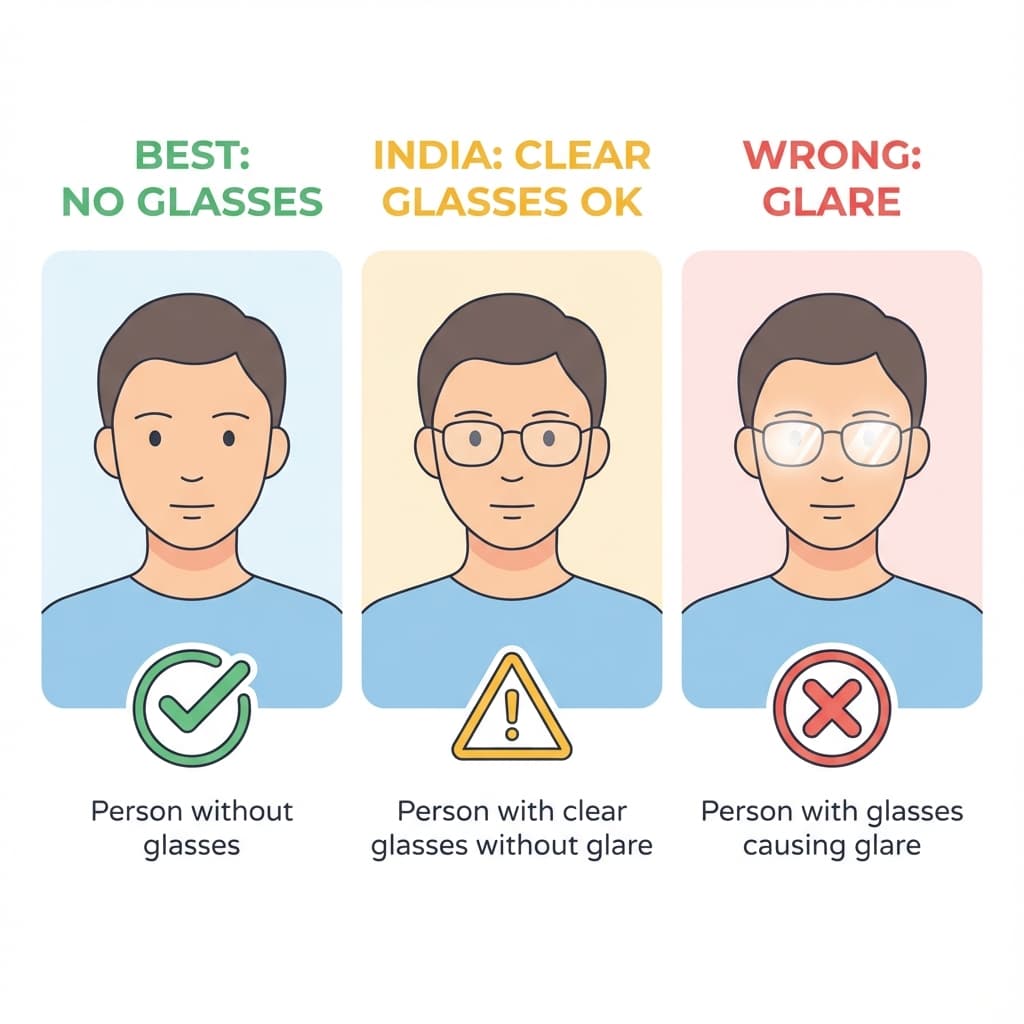
The basic rule is simple: if the glasses make it harder to see your eyes clearly, they create a risk. Even when glasses are technically allowed, reflections, shadowing, and dark or tinted lenses can make the photo unacceptable.
May Be Allowed
- ✅ Clear prescription lenses
- ✅ Glasses you wear daily
- ✅ Anti-reflective coated lenses
- ✅ Thin, non-decorative frames
Never Allowed
- ❌ Sunglasses (any type)
- ❌ Tinted lenses
- ❌ Photochromic/transition lenses (if darkened)
- ❌ Glasses with glare covering eyes
If you are unsure, take one photo with glasses and one without. Comparing them side by side makes it easier to see whether the lenses are creating a reflection, narrowing the eyes, or changing the overall look too much. In many cases, the glasses-free version is simply easier to approve.
Country-Specific Rules
Different countries interpret eyewear rules differently, so it is worth checking the specific document type before you print or upload anything. A photo that is fine for one application may be rejected for another if the rules are stricter.
| Country | Allowed? | Notes |
|---|---|---|
| India | ✅ Yes | Clear glasses OK, no glare |
| United States | ❌ No | NO glasses since 2016 |
| UK | ✅ Yes | Clear glasses OK, no glare |
| Schengen/EU | ✅ Yes | Clear glasses OK |
| Canada | ✅ Yes | Clear glasses OK |
| Australia | ✅ Yes | Clear glasses OK |
US Visa Warning
The United States strictly prohibits eyeglasses in visa photos since November 2016. This applies to all US visas (B1/B2, H1B, F1) and US passport applications.
If you are preparing photos for multiple countries, the easiest way to stay safe is to create one version without glasses unless you have a specific rule that allows them and the lenses stay perfectly clear. This reduces the chance of confusion later.
Avoiding Glare on Glasses
Glare is usually the real problem, not the glasses themselves. Even a perfectly legal pair of clear lenses can fail if a lamp, window, or flash reflects directly into the lens and hides the eyes. That is why light placement matters so much.
Glare Prevention
- ✅ Angled lighting: Position lights at 45° angles
- ✅ Slight head tilt: Tilt chin down to angle glasses
- ✅ Diffused light: Use soft, diffused lighting
- ✅ Clean lenses: Remove all smudges
- ✅ Multiple shots: Take many photos and check each
A few small adjustments usually solve most glare issues. Move the light source a little higher, ask the subject to lower the chin slightly, and avoid placing bright windows directly in front of the glasses. If one lens is still reflecting, rotate the frame carefully rather than moving the head too much.
Types of Eyewear: What's Allowed?
Not every type of eyewear gets treated the same way. Clear prescription glasses are the most likely to be accepted, while decorative frames, dark lenses, and color-changing lenses create more risk because they change the appearance of the eyes.
| Type | Allowed? |
|---|---|
| Clear prescription glasses | ✅ Usually |
| Sunglasses | ❌ Never |
| Tinted lenses | ❌ No |
| Transition lenses | ⚠️ Must be clear |
| Colored contacts | ❌ No |
If your glasses are part of your normal daily look, that helps with consistency, but it does not override the core photo rule: the eyes still need to be visible. When in doubt, remove anything that darkens or hides the eye area.
Frequently Asked Questions
Can I wear glasses in Indian passport photo?
Yes, clear prescription glasses are allowed for Indian passport photos. Your eyes must be fully visible without any glare on the lenses. Tinted lenses are not permitted.
Can I wear glasses in US visa photo?
No. Since November 2016, the US does NOT allow glasses in visa or passport photos, except for rare documented medical necessity.
What about sunglasses for passport photos?
Sunglasses are NEVER allowed in any passport or visa photo, regardless of country.
How do I avoid glare on glasses in photos?
Position lights at 45-degree angles, tilt head slightly down, clean glasses thoroughly, and use diffused lighting.
Are anti-glare glasses better for passport photos?
Yes, glasses with anti-reflective coating are much easier to photograph without glare.
Can I wear reading glasses in my passport photo?
Only if you wear them regularly. Photos should represent your everyday appearance.
What if I cannot see without my glasses?
Remove glasses just for the photo moment. Focus on camera position and have someone guide you.
Are colored contact lenses allowed in passport photos?
No, colored contacts that change eye color are not allowed. Your photo must show natural eye color.
What if my glasses leave marks on my nose?
Remove glasses 5-10 minutes before the photo to allow marks to fade.
Should I wear glasses in passport if I had LASIK?
No. If you no longer need glasses, do not wear them in your passport photo.
Should I keep my glasses on if I wear them every day?
Only if the glasses are allowed for that document and the lenses stay fully clear. If there is any reflection or doubt, removing them is usually the safer route.
Do thick frames cause rejection?
Thick frames are not automatically a problem, but they can block part of the face or create stronger shadows. Thin, simple frames are usually easier to photograph cleanly.
Is it okay to remove glasses just for the photo?
Yes. The goal is to create a compliant document image, so removing glasses for a few minutes is often the easiest way to get a clean result.
Quick decision checklist
- • Are the eyes clearly visible without shadow or glare?
- • Does your document type allow glasses at all?
- • Are the lenses clear and free from tint?
- • Would a glasses-free photo look simpler and safer?
- • Have you checked the image at full size before submitting?
If you answer yes to the first two points and no to the last three risks, you are in a better position to keep the glasses on. If the answer is mixed, the glasses-free version is usually the more reliable choice.
Next practical step
After reading the guide, open the matching tool or reference page so capture, crop, upload, and print prep stay in the right order.
Create Your Passport Photo
Make a 35x45mm photo, download a digital file, or create a print-ready sheet.
Create Photo Free →