Schengen Visa Photo Requirements
Specifications for European Schengen visa photos. Valid for all 27 Schengen area countries.
Quick Overview
Schengen visa photos are a good example of a rule that looks simple but still trips people up. The format is not square, the face must be well centered, and the image has to match biometric standards that embassies and visa centers expect across Europe.
If you are used to Indian passport photos, the main adjustment is the portrait format. Schengen uses 35mm by 45mm, which means a square passport crop will not work. The safest workflow is to prepare the photo specifically for Schengen rather than reusing a square image and hoping the crop will be accepted.
One-Line Summary
Think portrait, not square; neutral expression, not a smile; and clean background, not creative editing. Those three choices solve most of the problem before it starts.
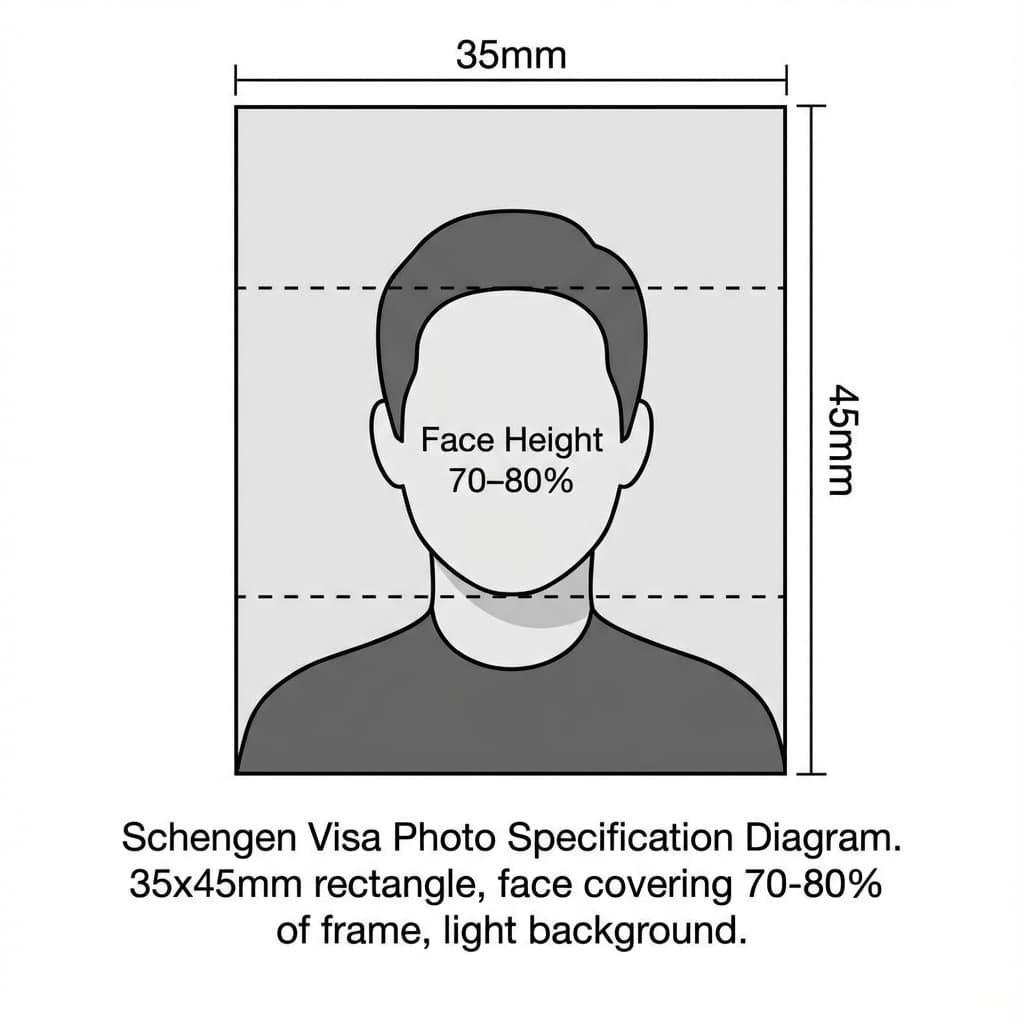
Photo Specifications
The photo must show your full face clearly, with enough space above the head and below the chin. A crop that is too tight makes the photo feel cramped, while a crop that is too loose can make the face too small for the biometric template.
| Size | 35mm × 45mm |
| Background | Light grey, white, or light blue |
| Face Coverage | 70-80% of photo height |
| Head Height | 32-36mm from chin to crown |
| Expression | Neutral, mouth closed |
| Eyes | Open, looking at camera |
| Photo Age | Within 6 months |
Size Comparison
Schengen: 35×45mm | UK: 35×45mm | India/US: 2×2 inch square (2×2 inches)
Because Schengen and UK photo sizes are the same, many people can reuse the same image for both applications if the background and framing also fit. That said, always check the specific embassy instructions before submitting the same file twice.
Biometric Standards
Schengen photos must meet ICAO biometric standards. That means the image needs to be machine-readable, visually clean, and free from anything that makes the face hard to detect.
- Face centered and looking directly at camera
- Neutral expression with mouth closed
- Eyes clearly visible without glare
- No head coverings except religious
- High resolution (minimum 300 DPI)
In practical terms, that means no tilted head, no strong shadows, no artistic backgrounds, and no editing that changes your features. The most acceptable photo is usually the most ordinary-looking one, because it looks like a straightforward identity image.
Do
- ✅ Ensure face covers 70-80% of frame
- ✅ Use light, uniform background
- ✅ Keep hair away from face
If you wear glasses, remove them unless the mission explicitly allows them and you can avoid glare completely. Even when glasses are technically allowed, removing them is often the safer choice because it reduces the chance of a rejection for reflections.
Digital Tips
Schengen applications do not all use the exact same upload system, but the digital photo still needs to be clean, sharp, and correctly sized. When in doubt, export a simple JPEG with a balanced crop rather than a heavily compressed file.
A practical workflow is to keep the image at high resolution, crop it to the 35x45mm ratio, and then reduce file size only as much as necessary. If the background looks uneven, fix the lighting first instead of trying to hide it with heavy editing.
Helpful Habit
Save a print-ready copy and a web-upload copy. That gives you flexibility if a visa center asks for a physical print later or if the portal needs a smaller file.
Schengen Area Countries
These specifications apply to all 27 Schengen countries:
Austria, Belgium, Croatia, Czech Republic, Denmark, Estonia, Finland, France, Germany, Greece, Hungary, Iceland, Italy, Latvia, Liechtenstein, Lithuania, Luxembourg, Malta, Netherlands, Norway, Poland, Portugal, Slovakia, Slovenia, Spain, Sweden, Switzerland.
If your trip includes more than one country, the photo rule still stays the same. What can change is the submission process, so the embassy or visa center for your main destination should always get the final check.
Final Checklist
Before you submit, slow down for one last review. A final checklist often catches the most common reasons for rejection, especially when the photo is being reused across different travel documents.
- Measure the size: Confirm the file is formatted to 35x45mm.
- Check the face height: Make sure the chin-to-crown area sits in the proper range.
- Review the background: Keep it plain, even, and free from color spots.
- Look at the eyes: They must be visible, sharp, and not blocked by glare.
- Keep copies ready: Save both digital and printed versions for flexibility.
If you need a reference for a portrait-style visa photo, you can compare your result with the UK visa photo guidesince the size rules are the same. The extra check is useful when you are unsure about crop or background tone.
Common Mistakes
Most Schengen rejections are caused by avoidable details, not by anything exotic. The usual problems are a wrong crop, a face that is too small, or a background that is not uniform enough for a strict biometric review.
- Using a square passport crop instead of a 35x45mm portrait frame
- Letting shadows fall behind the head or across the cheeks
- Using a bright blue or patterned backdrop that looks decorative instead of neutral
- Editing the face too much with filters or skin smoothing
- Uploading an old photo that no longer matches your current look
The safest way to avoid those issues is to take the photo in plain daylight or soft indoor light, frame the face carefully, and keep the final image as natural as possible.
If you are working from a mobile phone, take a few test shots first and compare them at full size. A small adjustment in distance or height can make the difference between a photo that feels compliant and one that looks slightly off.
When in doubt, favor the version that looks the least edited. Visa officers want a photo that is easy to compare against your face in person, and natural-looking images usually pass that test more comfortably than heavily stylized ones.
Frequently Asked Questions
What size is required for Schengen visa photo?
35mm × 45mm (width × height). Face must cover 70-80% of the photo height. This is the standard for all 27 Schengen countries.
Is Schengen photo same as UK visa photo?
Yes, both are 35×45mm. However, they differ from Indian passport (2×2 inch square) and US visa (2×2 inch square) which are square format.
What background color for Schengen visa photo?
Light grey, white, or light blue backgrounds are accepted. Most embassies prefer light grey or pure white. Avoid colored or patterned backgrounds.
Can I wear glasses in Schengen visa photo?
Clear prescription glasses are allowed if there is no glare. However, removing glasses is recommended to avoid any issues with reflections.
How recent must my Schengen photo be?
The photo must be taken within the last 6 months and must represent your current appearance. Old photos will be rejected.
What is the face size requirement for Schengen?
Your face (chin to crown of head) must be 32-36mm in height, covering 70-80% of the photo. Face should be centered in the frame.
Can I smile in Schengen visa photo?
No, you must maintain a neutral expression with your mouth closed. Smiling or other expressions will cause rejection.
What are the digital photo requirements for Schengen?
Digital photos should be at least 600×800 pixels, in JPEG format, and between 50KB to 500KB file size depending on the specific embassy.
Do all Schengen countries accept the same photo?
Yes, the 35×45mm specification is standard across all 27 Schengen area countries. One photo format works for all.
What if my photo gets rejected for Schengen visa?
You will need to provide a new photo meeting specifications. Common rejection reasons include wrong size, shadows, wrong expression, or old photo.
Should I bring printed photos even if I uploaded digitally?
Yes, if your visa center or document checklist asks for them. Keeping printed copies ready is a simple backup and avoids last-minute problems.
Can I use the same Schengen photo for a UK visa?
Usually yes, because UK visa photos also use 35x45mm. Still, check the final instructions for the specific country or visa center before submitting.
What background is safest for Schengen photos?
Plain white or very light grey is usually the safest choice. If you are unsure about light blue, choose a neutral background that looks clean and even rather than decorative.
How should I decide if the face is the right size?
The face should take up most of the frame without feeling crowded. If the head looks tiny, the crop is too loose; if it nearly touches the top edge, it is probably too tight.
Can I retake the photo at home if I already have a studio copy?
Yes. If the studio print looks inconsistent or the background is not even, a home retake with better light is often a better answer than trying to fix a weak original.
What if my photo is accepted by one Schengen country but not another?
Follow the stricter instruction set if there is any mismatch. In practice, most rejections come from the same crop or background issue, so a cleaner image usually solves the problem across countries.
Should I avoid wearing white clothing for Schengen photos?
Yes, lighter clothing is not forbidden, but stronger contrast with the background is usually safer. A shirt with more contrast helps the face stand out without blending into the backdrop.
How old can the Schengen photo be?
It should be taken within the last 6 months. If your current appearance has changed noticeably, a fresh photo is the safest option even if the old one is technically recent.
Can I use a digital photo editor for Schengen crops?
Yes, as long as the edit stays natural. Use the editor for crop and size, not for filters, smoothing, or feature changes that make the face look different from real life.
What should I do if the head is too large in the final image?
Start again from the original and expand the frame slightly. A large head can look cramped and make the top of the hair too close to the edge, which feels less compliant.
Next practical step
After reading the guide, open the matching tool or reference page so capture, crop, upload, and print prep stay in the right order.
Create Your Passport Photo
Make a 35x45mm photo, download a digital file, or create a print-ready sheet.
Create Photo Free →